The Labor Equation: What AI Does to Jobs, Industries, and the Economy by 2030
The disruption is not coming for blue-collar workers first. It is coming for knowledge workers — the most educated, highest-paid layer of the global workforce. Here is the honest accounting.

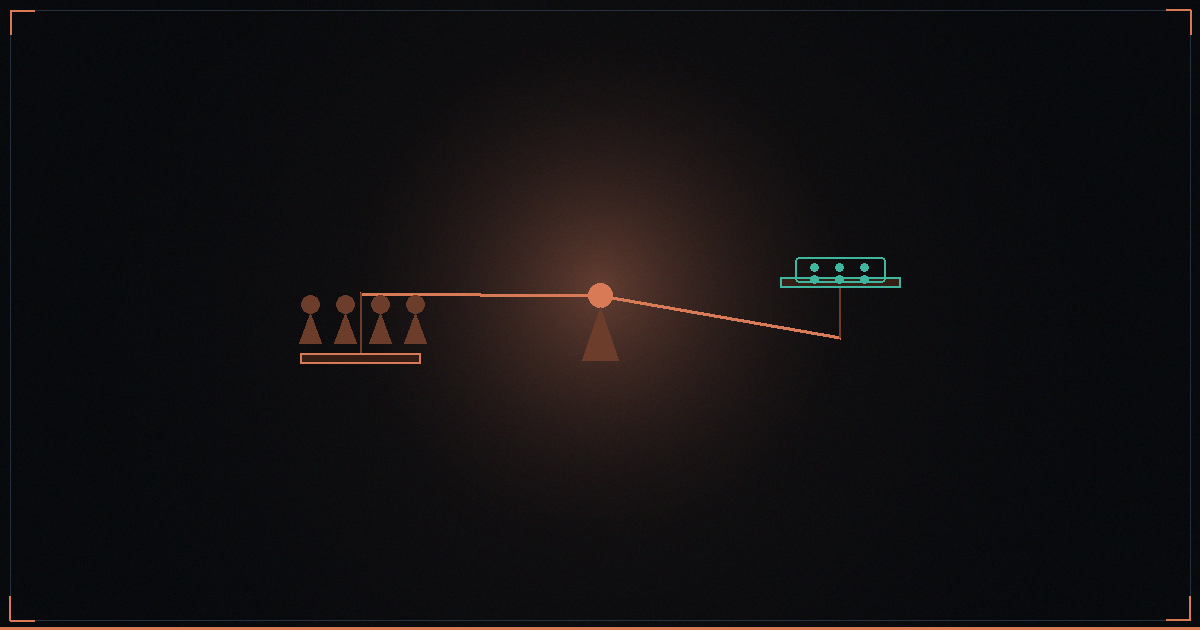
Every major technology revolution has disrupted labor. The agricultural revolution made nomadic hunter-gatherer economies obsolete. The industrial revolution made artisan craft production obsolete. The digital revolution made a generation of clerical and administrative jobs obsolete. AI is the fourth revolution — and it is targeting the cognitive layer of the economy in the same way the industrial revolution targeted the physical layer.
The difference is speed. Previous revolutions unfolded over generations, giving labor markets time to adapt, retrain, and find new equilibria. AI is unfolding over years. The policy frameworks, educational systems, and social safety nets designed for slower transitions are not calibrated for this velocity.
Which Jobs Are Actually at Risk
The jobs most vulnerable to AI displacement share a specific profile that cuts across traditional education and income categories. They are characterized by high information content, defined output formats, learnable rules, and limited requirement for physical presence or genuine interpersonal judgment.
This profile describes a surprising proportion of high-income professional work. Legal research and document review. Financial analysis and reporting. Medical coding and prior authorization. Academic research synthesis. Marketing copywriting. Basic software engineering. Architectural drafting. Accounting and tax preparation. Radiology interpretation is already being disrupted by AI diagnostic systems that match or exceed radiologist accuracy on specific tasks.
The jobs that are most resilient to AI displacement share a different profile: they require physical presence and dexterity in unstructured environments, genuine interpersonal judgment under emotional complexity, creative vision that requires understanding of human meaning and context, or accountability that must be carried by a specific individual rather than a system.
Electricians, plumbers, and skilled tradespeople are more resilient than many assume. The dexterity and situational judgment required in physical environments is harder to automate than the analysis required in information environments. The surgeon who performs complex procedures is more resilient than the radiologist who reads scans. The therapist who holds space for human pain is more resilient than the psychiatrist who prescribes medication based on symptom checklists.
The Economic Math
Goldman Sachs research published in 2023 estimated that generative AI could expose three hundred million full-time jobs globally to automation. McKinsey's updated estimates suggest sixty to seventy percent of current work activities could be automated by existing AI technologies. These are not science fiction projections — they are assessments of what current technology, deployed at scale, could do to existing job structures.
The historical counter-argument is that technology has always created more jobs than it destroys. The printing press eliminated scribes and created publishers. The automobile eliminated stable hands and created mechanics, road builders, and petroleum engineers. The computer eliminated bookkeepers and created software developers, data analysts, and IT support.
This counter-argument may be correct over a multi-decade horizon. The uncertainty is whether the new jobs will emerge at a speed and in locations that match the displacement — and whether the educational and retraining infrastructure exists to make the transition.
The Wage Polarization Effect
The intermediate scenario — neither total displacement nor frictionless adaptation — is wage polarization. AI augments highly skilled workers, dramatically increasing their productivity and therefore their value. It substitutes for routine cognitive workers, reducing demand for their labor and therefore their wages.
The result is a widening gap between the people who direct AI systems and the people whose jobs AI systems are replacing. This dynamic is already visible in the data: software engineers with AI skills command thirty to forty percent salary premiums over those without. Knowledge workers who can effectively use AI tools are completing work in hours that previously took days. Their employers capture much of that productivity gain, but the workers retain enough to pull ahead of their non-AI-augmented peers.
The people who fall behind are those in the middle: knowledge workers with skills that AI can partially or fully replicate, who lack the technical sophistication or capital to direct AI systems, and whose employers are under competitive pressure to capture AI cost savings.
The Policy Gap
No major government has a coherent policy response to AI labor displacement that operates on the relevant timescale. Universal basic income pilots exist but are politically contested and economically unproven at scale. Retraining programs exist but are chronically underfunded and poorly matched to the actual skills demand created by AI. Educational systems are updating their curricula, but the update cycle is measured in years and the technology is moving in months.
This gap between the speed of technological disruption and the speed of institutional adaptation is not new. It is the characteristic condition of revolutionary technological periods. The question for individuals is not whether the institutions will adapt fast enough — they will not. The question is whether you are building the skills, the positioning, and the financial resilience to navigate the transition without depending on institutional response.
The Individual Response
The most durable response to AI labor disruption at the individual level is to move up the value chain toward the human capacities that AI amplifies rather than replaces.
The ability to specify — to articulate clearly what needs to be built, analyzed, or created, with enough precision that an AI system can execute without repeated clarification. This is the prompt engineering skill generalized: the capacity to translate human intention into system-legible instruction.
The ability to evaluate — to read AI output and accurately assess its quality, identify its errors, and know when it is confidently wrong. This requires genuine domain knowledge. The human who can tell the difference between good AI output and convincing-but-wrong AI output is irreplaceable. The human who cannot is replaceable.
The ability to direct — to take responsibility for strategy, vision, and outcomes rather than just execution. Execution is automatable. Direction — knowing where to point the machine — remains deeply human.
The labor equation is being rewritten.
The people who understand the new math early will write their own terms.
Everyone else will negotiate from weakness.