The Zero Headcount Playbook: Running a Seven-Figure Operation with an AI-First Team
The traditional playbook says more revenue requires more people. The AI-first playbook says more revenue requires better systems. Here is the operating model that makes seven figures achievable with a team of two.

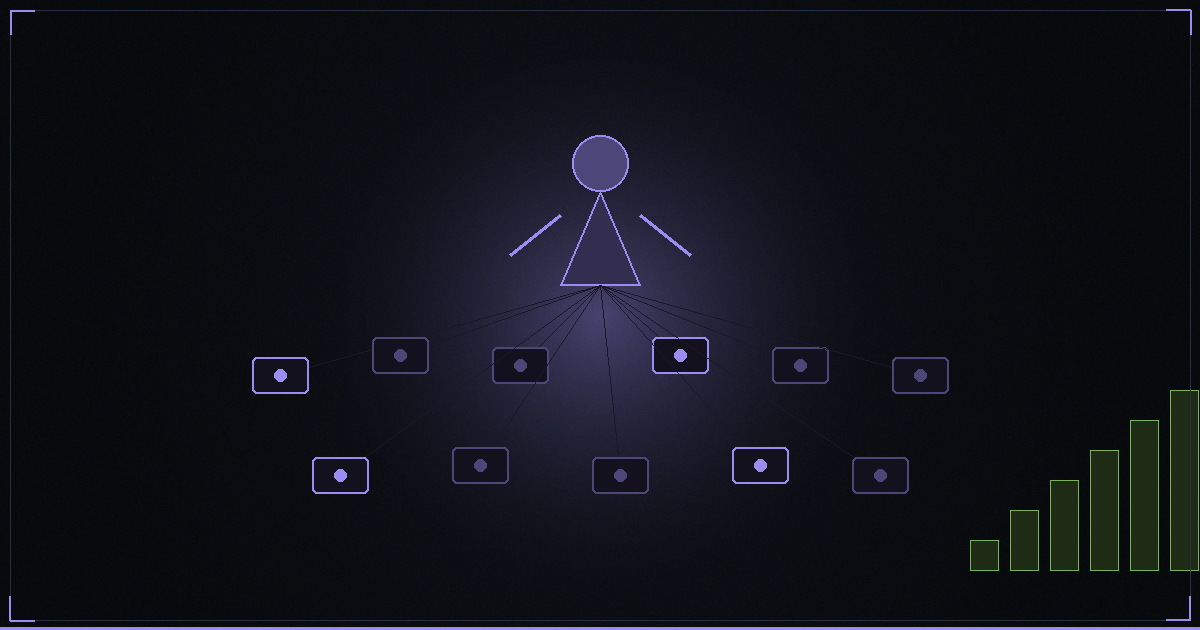
The traditional playbook for building a service business is simple and brutal: land clients, hire people to serve them, manage the people, repeat. Revenue scales with headcount. Headcount creates overhead. Overhead requires more revenue. The treadmill runs until you either build something big enough to justify the infrastructure or burn out managing the complexity of a growing human organization.
The AI-first playbook breaks this cycle. It says: land clients, build systems to serve them, refine the systems, and scale without proportional headcount growth. Revenue scales with system quality. System quality improves automatically. Overhead stays flat. The business compounds without the management complexity.
This is not theoretical. It is the operating model of a growing number of AI-native service businesses, including Theta Intelligence. Here is how it actually works.
The Stack That Makes It Possible
Every zero-headcount playbook runs on a similar stack, though the specific tools vary.
The client interface layer handles all client-facing communication — inbound inquiries, status updates, deliverable delivery, and reporting. In practice, this means an email workflow that drafts responses for human review, a client portal that surfaces real-time status without requiring check-in calls, and automated reporting that compiles from system data rather than requiring human assembly.
The work execution layer is where the intelligent systems do the actual work. For a content business, this is the AI writing and editing pipeline. For an outbound sales operation, this is the research, personalization, and sequencing system. For an analytics business, this is the data collection, processing, and insight generation pipeline. The work execution layer is the core IP of the business — it is what you are actually selling, automated.
The quality assurance layer is where humans spend the majority of their time. Not executing the work — reviewing it. The human in a zero-headcount operation is primarily an editor, a curator, and a quality gatekeeper. They review AI-generated outputs, approve the ones that meet standard, correct or regenerate the ones that do not, and feed corrections back into the system for learning.
The business operations layer handles everything that keeps the company running: invoicing, contract management, financial reporting, tax compliance, vendor management. This layer is almost entirely automatable with existing tools — accounting software, contract management platforms, payment processors, and a bookkeeper who reviews the automated outputs quarterly.
The Revenue Per Person Math
Traditional professional services generate two hundred to five hundred thousand dollars of revenue per full-time employee, depending on the sector and the seniority mix. This number is relatively stable because it is bounded by human productivity.
AI-first operations can generate multiples of this ratio. The exact multiple depends on the quality of the systems, the pricing power of the service, and the proportion of work that has been successfully automated. Early-stage AI-first businesses commonly operate at two to three times the revenue-per-person ratio of traditional competitors. Mature implementations can reach five to ten times.
The implication: a two-person AI-first operation can generate revenue that would have required a twenty to forty-person traditional operation. The difference is not the people. It is the systems.
Where the Human Remains Non-Negotiable
The zero-headcount framing is aspirational, not literal. There are functions that require human judgment and human relationship that cannot be automated without destroying the business.
Client acquisition at the relationship level. The first conversation with a prospective client. The negotiation. The trust-building that turns a transaction into a long-term engagement. AI can generate the outreach, research the prospect, draft the proposal, and prepare for the conversation. The human has the conversation.
Strategic advisory. For clients who are paying for judgment, not just execution, the judgment has to come from a human. AI can surface the data, generate the options, and model the scenarios. The human synthesizes it into a recommendation that the client can hold someone accountable for.
Crisis management. When something goes wrong — and in any service business, things go wrong — the client needs to talk to a human. The empathy, the accountability, the relational repair that follows a failure are irreducibly human. The system can flag the problem and prepare the talking points. The human makes the call.
Building This at Theta Intelligence
At Theta Intelligence, the zero-headcount playbook is the operating model. Client communications are handled through AI-assisted workflows that produce drafts for human review. Deliverables are generated by intelligent systems and reviewed by humans before delivery. Reporting is automated and compiled daily without manual assembly. Business operations run on automated infrastructure.
The human time in the operation goes to: strategic direction, client relationships, system design and refinement, and quality review. These are the high-value activities that compound. Everything else runs through the systems.
The result is a business that scales without proportional headcount growth, that improves automatically as the systems accumulate feedback, and that maintains quality standards that do not depend on any individual's sustained attention.
Revenue per person is the metric that matters.
Systems are what change it.
Build the systems. Compound the leverage.